| MAIN MENU |
| Editorial Team |
| About |
| Announcements |
| Contact |
| Current |
| Archives |
Focus and Scope
Jurnal Ilmu Keperawatan Indonesia (JIKPI) is registered with E-ISSN 2746-2579 (online) and focuses on the development and dissemination of scientific knowledge, research findings, and professional practices in the field of nursing. The journal welcomes scholarly articles covering, but not limited to, the following areas:
1. Basic Nursing
2. Medical-Surgical Nursing
3. Emergency and Critical Care Nursing
4. Pediatric Nursing
5. Maternity Nursing
6. Nursing Management
7. Family and Gerontological Nursing
8. Psychiatric and Mental Health Nursing
9. Community Nursing
10. Nursing Education
Peer Review Process
1. Manuscript Submission
Authors submit their manuscripts through the online submission system provided by JIKPI. Manuscripts must be prepared in accordance with the journal's author guidelines and applicable publication requirements.
2. Administrative and Editorial Screening
The editorial team checks the completeness, structure, formatting, and compliance of the manuscript with the JIKPI author guidelines. At this stage, the screening focuses primarily on administrative and technical requirements rather than an in-depth assessment of the manuscript's scientific quality.
3. Initial Assessment by the Editor-in-Chief
The Editor-in-Chief conducts an initial assessment to determine whether the manuscript is appropriate for the focus and scope of JIKPI, demonstrates sufficient originality, and has academic relevance and potential scientific contribution. Manuscripts that fall outside the journal's scope or fail to meet the basic submission requirements may be rejected at this stage without proceeding to peer review.
4. Assignment to an Editor
Manuscripts that pass the initial assessment may be assigned to an Associate Editor or another editor with relevant expertise. The assigned editor is responsible for coordinating the peer review process and providing an editorial recommendation based on the reviewers' assessments.
5. Reviewer Invitation
The editor invites reviewers who possess appropriate expertise and competence related to the subject of the manuscript. JIKPI aims to have each manuscript evaluated by at least two independent reviewers. Invited reviewers are expected to consider their expertise, potential conflicts of interest, and availability before accepting or declining the review invitation.
6. Reviewer Response to the Invitation
Potential reviewers evaluate the invitation based on their area of expertise, possible conflicts of interest, and availability. Reviewers may accept or decline the invitation. When appropriate, they may also recommend alternative reviewers to the editor.
7. Peer Review
Reviewers critically and objectively evaluate the manuscript, including its originality, methodology, validity of data and analysis, discussion, quality of references, and scientific contribution. Reviewers then provide constructive comments and a recommendation to the editor, which may include acceptance, minor revision, major revision, or rejection.
8. Editorial Evaluation of Review Reports
The editor evaluates all submitted review reports and considers the reviewers' comments and recommendations before making an editorial decision. If substantial differences arise between the reviewers' assessments, the editor may seek an additional review before reaching a final decision.
9. Editorial Decision and Notification
The editor makes an editorial decision based on the peer review results and academic considerations. The decision is communicated to the authors through the journal's online system, together with relevant reviewers' comments and recommendations. If revisions are required, authors must revise their manuscripts in accordance with the comments and recommendations of the reviewers and editor within the specified timeframe.
Publication Frequency
Jurnal Ilmu Keperawatan Indonesia (JIKPI) is published and managed by the Institute for Research and Community Service (LPPM), Universitas Mitra Indonesia. JIKPI is published twice a year, in March and September.
Open Access Policy
Jurnal Ilmu Keperawatan Indonesia (JIKPI) provides immediate open access to its content on the principle that making research freely available to the public supports a greater global exchange of knowledge.
All articles published in Jurnal Ilmu Keperawatan Indonesia (JIKPI) are licensed under a Creative Commons Attribution 4.0 International License (CC BY 4.0). Users are allowed to read, download, copy, distribute, print, search, or link to the full texts of the articles without prior permission from the publisher or the author, provided the original work is properly cited.
Journal History
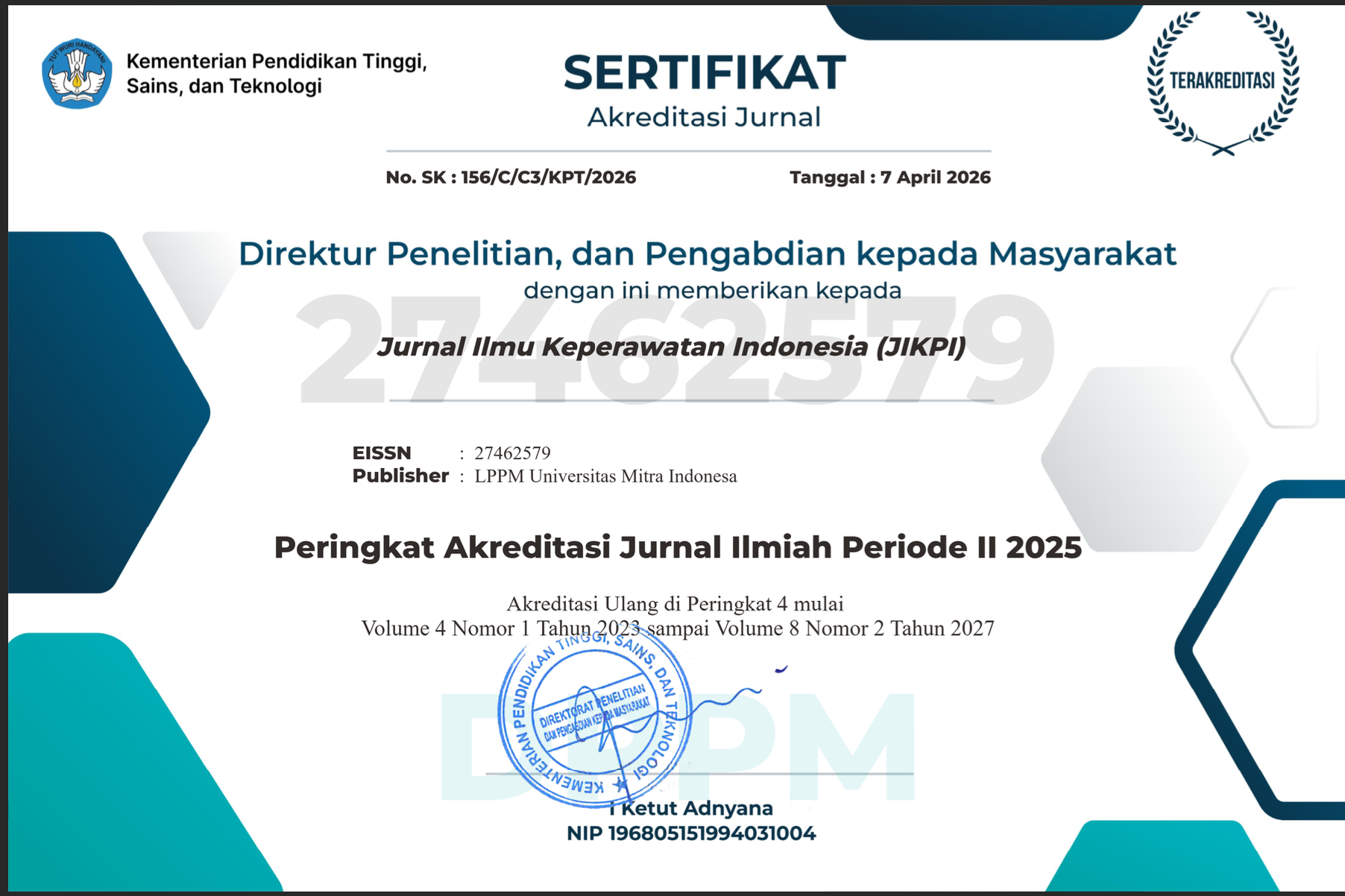
Jurnal Ilmu Keperawatan Indonesia (JIKPI) is an open-access peer-reviewed journal published by the Institute for Research and Community Service (LPPM), Universitas Mitra Indonesia, to support the dissemination of high-quality scientific research and developments in the field of nursing science.
- E-ISSN (Online): 2746-2579
- DOI Prefix: 10.57084/jikpi
- Publisher: LPPM Universitas Mitra Indonesia
- URL: https://jurnal.umitra.ac.id/index.php/JIKPI/index